
Located in one of the United States’ fastest-growing cities, UT Austin’s McCombs School of Business is increasingly a top-choice program for savvy MBA applicants.
However, with a strong focus on entrepreneurship and access to the massive Longhorn network, the competition to join McCombs’ MBA program is increasingly steep.
That’s why we’ve prepared this guide to help you use your McCombs admissions essays to stand out. We’ve rounded up our best tips to ensure you give your UT McCombs application your best shot.
1. Who is McCombs looking for?

(Photo courtesy of @utexasmccombs on Instagram)
“It has been said that McCombs MBAs are relentlessly driven, yet they are the first to jump in and encourage and support each other to excel.” Texas McCombs MBA Insider
This year, McCombs admitted 255 students to its highly-competitive MBA program. With a strong emphasis on diversity, there is no “typical” McCombs student, yet the average student admitted to the Class of 2026 had an average GMAT score of 704 or a GRE of 159V/162Q and 6 years of work experience.
Additionally, McCombs is looking for candidates who want to make a positive impact on the world through their careers. If this sounds like the community for you, you’ll face the challenging task of convincing the school’s admissions committee that you deserve to be a Longhorn.
2. How should I answer the essay questions?
2.1. Essay 1 Tips
Essay 1: At Texas McCombs, we do things a little differently. We embrace those who take the initiative and forge new paths. What ambitious goal or change do you aim to achieve with an MBA, and why is Texas McCombs your ideal launch pad? (250 words)
This prompt is McCombs’ version of a “future retrospective.” They want you to paint a compelling picture of your success at their school while demonstrating that you’ve done serious homework about their program. Essentially, they’re asking you to prove that you can envision yourself thriving in their specific ecosystem, not just any MBA program.
The genius of this question lies in its multiple layers. McCombs isn’t just asking why you want an MBA or even why you want their MBA. They’re asking you to demonstrate deep knowledge of their offerings while showing clear intentionality about how you’d maximize every aspect of the experience. This means you can’t get away with generic statements about “great professors” or “strong alumni network.”
When approaching the academic component, you need to go beyond surface-level course mentions. Instead of saying “I took finance classes to strengthen my analytical skills,” you might write: “Professor Wilson’s Private Equity course and the student-managed Venture Fellows program gave me hands-on experience analyzing early-stage investments, directly preparing me for my post-MBA role in venture capital.” This shows you’ve researched specific faculty, understand how courses connect to real-world application, and can articulate concrete career relevance.
The hands-on learning component is where McCombs really wants to see you understand their emphasis on experiential education. This is your opportunity to reference their signature programs like the Austin Technology Incubator collaboration or consulting projects with local businesses. You should demonstrate how these experiences would bridge the gap between classroom theory and professional practice in your specific career trajectory.
Perhaps most importantly, the community contribution element reveals whether you see the MBA as a two-way street. McCombs wants students who will enhance their program, not just benefit from it. If you’re a military veteran, maybe you’d revitalize the Veterans Club with new programming. If you have tech startup experience, perhaps you’d mentor teams in the Texas Venture Labs program. The key is connecting your unique background to specific ways you’d add value to the McCombs community.
When sitting down to write your essay, your strategic approach should weave these elements together in a cohesive narrative. Start by setting the scene with a brief reflection on your transformative MBA experience.
Then, state your short-term and long-term goals, why you want to pursue these goals, and the impact you hope they have. After all, what you’re going to study at UT is directly related to the goals you plan to pursue upon graduation!
TOP TIP: Need more help figuring out your goals? Check out this post.
Finally, dive into specific examples of academic growth, experiential learning, and community contribution. Throughout, maintain the future retrospective voice while grounding every claim in specific McCombs resources and programs you’ve researched.
Write Essays That Make Admissions Say Yes
Generic essays get generic results. Your story drowns in thousands of others the adcom is going through, and you get dinged. Ouch!
That’s why My Admit Coach helps you uncover the unique stories only you can tell, then guides you to turn them into compelling, high-impact essays.
Trained on 10+ years of real admissions success stories and frameworks from the world’s #1 rated MBA consultant, the platform gives you everything you need to uncover, shape, and polish the stories that define who you are.
With hundreds of painstakingly developed prompts, you’ll dig deeper into your motivations, achievements, and impact, guided by AI that understands what makes great essays great.
Our system even includes school-specific feedback simulations, mirroring real admissions committee discussions so you can see how your essay would be read behind closed doors.
Need a second opinion? Ellin’s AI clone is always there, ready to brainstorm new ideas, test angles, or fine-tune your structure until every line feels right.
Get instant feedback, exceptional output quality, and the kind of insight that only comes from human + technology working together – all for less than $300.
Start your free trial and turn your essays from average to attention-grabbing.
2.2. Essay 2 Tips
Essay 2: Reflect on a core value that defines you. Share a specific example of how it has guided your decisions and actions, and explain how it will shape your contributions and growth as a McCombs MBA student. Highlight how this value has influenced your leadership style and life path, and how it will shape your MBA experience.
This essay is fundamentally a character assessment disguised as a values discussion. McCombs wants to understand your moral compass, decision-making framework, and how you’ll contribute to their collaborative, values-driven culture. They’re not just asking what you value. Instead, they want to see how your values translate into action and leadership.
One common mistake is choosing values that are too broad or obvious without bringing a fresh perspective. Another pitfall is selecting an impressive-sounding value that doesn’t genuinely drive your decisions. McCombs will sense authenticity, so choose something that truly defines how you navigate the world.
The challenge here is choosing a value that feels authentic rather than what you think sounds impressive. Everyone values “integrity” or “hard work,” but McCombs wants to understand what makes you unique. Consider values like intellectual humility, radical transparency, or thoughtful dissent. The key is selecting something that genuinely drives your decisions and can be illustrated through a compelling, STAR-format story.
Your specific example needs to be more than just a situation where your value was present. It should be a moment where your value was tested, challenged, or crucial to the outcome.
This is where the STAR method becomes essential. Perhaps you chose intellectual humility when leading a failing product launch, organizing listening sessions with customers and critics instead of pushing your original strategy. Or maybe your value of inclusive excellence led you to restructure your team’s decision-making process to ensure all voices were heard, resulting in breakthrough innovations.
The connection between your value and your leadership style should feel natural and specific. If intellectual humility is your core value, you might be a leader who asks more questions than you give answers, who creates psychological safety for dissenting opinions, and who builds stronger teams through inclusive decision-making. This isn’t just about describing your leadership approach. It’s about showing how your value creates a distinct leadership philosophy.
When discussing how this value has influenced your life path, think broadly about career choices, personal relationships, and major decisions. Has your commitment to this value led you to take certain risks, choose specific employers, or pursue particular opportunities? This helps McCombs understand the consistency and depth of your character.
The McCombs application component requires specific research and thoughtful connection. If your value is intellectual humility, perhaps you’d contribute by fostering psychological safety in study groups, bringing diverse perspectives to case discussions, or leading initiatives that amplify underrepresented voices in the MBA community. The key is showing how your value would enhance the specific culture and community McCombs has built.
TOP TIP: Remember that this essay needs to work in harmony with your first essay and overall application. If Essay 1 highlights your analytical and strategic thinking, Essay 2 might showcase your collaborative and inclusive leadership style. Together, they should paint a complete picture of someone who would thrive in and enhance the McCombs community.
The most successful responses to this prompt will demonstrate that your value isn’t just something you believe in – it’s something that actively shapes how you lead, decide, and contribute to the communities you join.
2.3. Optional Essay Tips
Optional Statement: Please explain any gaps in work experience, choice of recommender, and/or academic performance issues that may help the admission committee in reviewing your application. (Limit: 250 words)
This is not a place for you to retell your life story or sum up your interest in McCombs or need for an MBA. It is also not a place to copy and paste a strong essay you wrote for another school. Make sure you focus only on weak spots and also discuss what steps you have taken or took to rectify the weaknesses AND/OR on any other topics that strictly need explanation. McCombs is quite clear when stating what types of explanations they feel are appropriate.
Of course, there are circumstances that are not covered in the list given, but it does make it very clear that essays on, for example, why you would like to live in Texas or everyone you know at UT will not work well for this prompt.
Find additional tips and tricks to help you master the optional essay here.
Looking for UT McCombs MBA essay examples?
Check out our real sample essays that got our clients admitted here.

3. Everyone’s Talking. We Help You Get Heard
Imagine walking into a noisy room. Everyone’s trying to make their case. That’s what the MBA application landscape feels like. Thousands of qualified applicants. Countless stories. A blur of achievements. And yet, the ones who break through are those with clarity, confidence, and a compelling voice.
That’s where we come in.
At Ellin Lolis Consulting, we don’t just edit essays. We help you find your voice, the one that cuts through the noise and resonates with admissions committees. With a 98.9% success rate and years of experience helping applicants get into top programs like HBS, Wharton, and INSEAD, we know exactly how to make your story stand out.
Whether you’re just getting started or stuck in the middle of your application process, our team of expert consultants offers personalized, one-on-one guidance that transforms your raw ideas into a compelling, cohesive application.
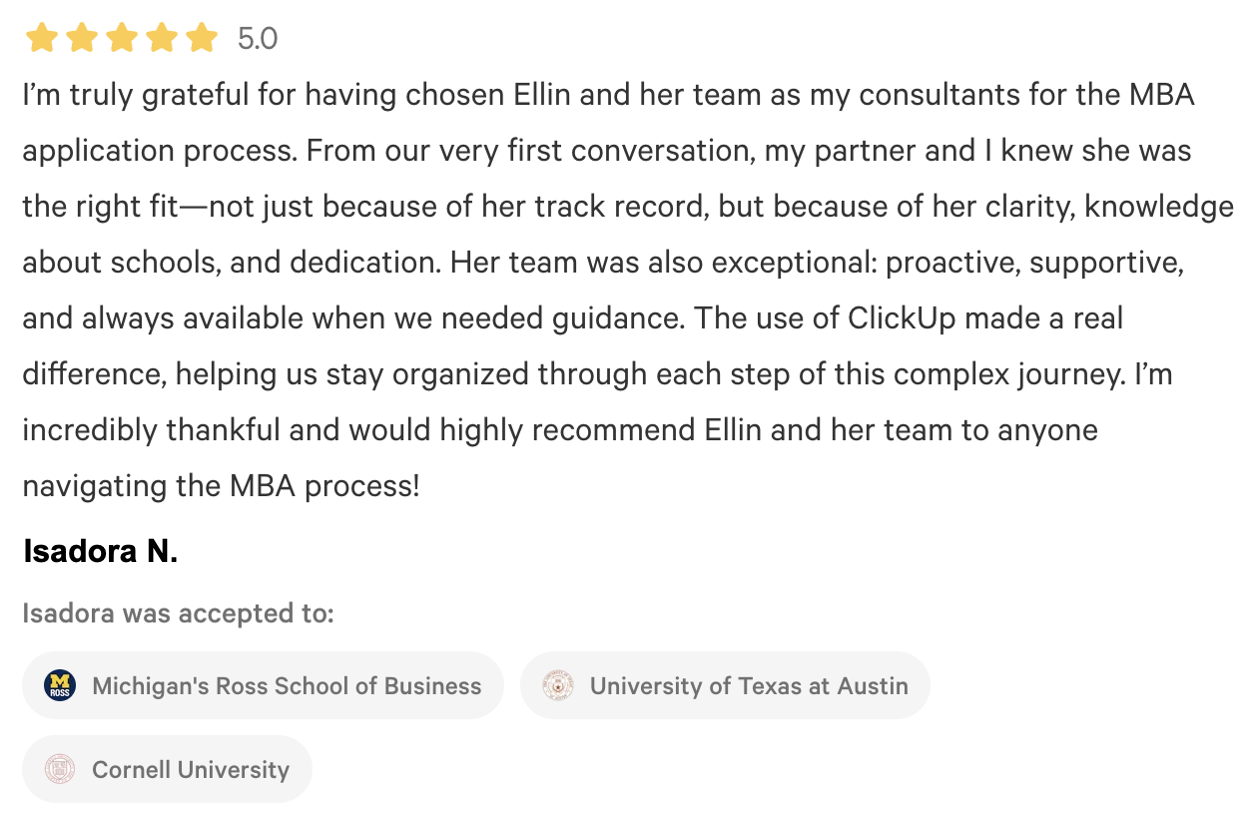
Just ask Isadora, who felt overwhelmed by the process but got into McCombs.
The room might be noisy, but your voice doesn’t have to be.
Learn more about working with us here. Let’s make your story the one that gets remembered.

4. UT McCombs Deadlines
Here are the deadlines for the 2025-2026 season. You can access the online application here.
Round 1
Application Deadline: October 15, 2025
Interview Notification: Ongoing
Decisions Released: December 16, 2025
Round 2
Application Deadline: January 15, 2026
Interview Notification: Ongoing
Decisions Released: March 26, 2026
Round 3
Application Deadline: April 1, 2026
Interview Notification: Ongoing
Decisions Released: May 7, 2026