
UPDATE: This article was originally posted on September 4, 2019. It has been updated with new information and tips below.
With its focus on immersion learning and campuses in both Ithaca and New York City, Cornell is at the top of the list for an increasing number of applicants who seek to pursue high-impact business careers.
However, with its unique 1-year MBA option and interface with leading tech companies, landing a spot at Cornell Johnson is more difficult than ever.
That’s why we’ve prepared this guide to help you use your Cornell admissions essays to stand out. We’ve rounded up our best tips and links to Cornell Johnson MBA sample essays to ensure you give your Cornell application your best shot.
1. Who is Cornell Johnson looking for?

(Photo courtesy of @cornellmba on Instagram)
“Innovation is fundamental to Johnson and to Cornell. Our emphasis on performance learning ensures that Johnson MBAs can make an immediate impact in business and society. That’s what they’re practicing, and that’s what they’re prepared to do.” Mark W. Nelson, PhD, Dean Samuel Curtis Johnson Graduate School of Management
Every year, Cornell recruits highly talented individuals from across the globe to fill its 1-year and 2-year MBA programs. Find complete class profile stats here.
Beyond the statistics, though, Cornell is looking for candidates who want to positively disrupt the world of business through outstanding leadership. That’s why, in addition to strong academic performance (demonstrated through the GMAT and university grades), Cornell also seeks candidates who demonstrate the following traits: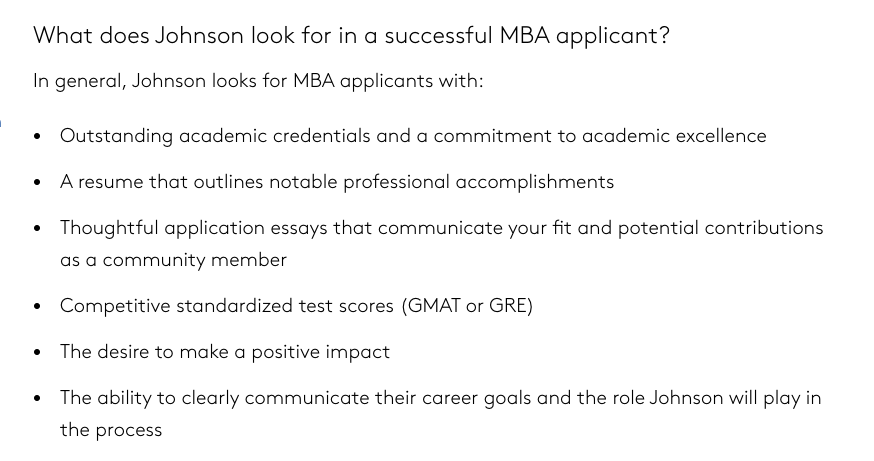
If this sounds like a community in which you’d be right at home, you’ll first have to prove you’ve got what it takes by successfully answering Cornell’s admissions essay questions.
2. How should I answer the essay questions
2.1. Short Essay Tips
Goals Statement: A statement of your goals will begin a conversation that will last throughout the admissions process and guide your steps during the MBA program and experience. To the best of your understanding today, please share your short and long term goals by completing the following sentences and answering the enclosed short answer question:
Immediately post-MBA, my goal is to work as a(n) [Role] at [Company] within [Industry].
Targeted Job Role:
Target Job Company:
Industry:
In 5–10 years post-MBA, my goal is to work as a(n) [Role] at [Company] within [Industry].
Targeted Job Role:
Target Job Company:
Industry:
Please share how you plan to utilize the resources available at Johnson, as well as any personal resources to transition to your immediate post-MBA career goal. (350 maximum)
Though a bit unorthodox in format, this is essentially a goals essay. For goals essays, the admissions committee wants to see that you have a clear, defined plan for the future that both makes sense based on your previous experience and that shows a clear connection between your short- and long-term goals.
For the text boxes, be brief and precise. Tell them exactly what you want to do.
For the longer essay, you have a bit more room, but not much!
That’s why we suggest not recapping your goals in this essay unless you need them to transition between the two parts I believe this essay should have: your previous experience and what motivates you to pursue the goals you’ve stated (to tie this to the question, you need to show how you’ve prepared, what existing resources you will bring and what has encouraged you to pursue your goals).
First, let’s start with how you’ve prepared and what you bring. Remember, goals without context often lack clarity or impact. You may want to include one mini-story or several small anecdotes to provide this context.
Don’t write a list of everything you’ve ever done (we have your CV after all!) but carefully craft a description of your path that shows us you’ve built skills and experience that are relevant to your future job.
Once you finish, I do suggest that you briefly mention your goals on a very high level, since this serves as a nice transition to the “Why Cornell” part of this essay. I then also suggest you briefly share the impact you hope to generate with this goal in a sentence. Don’t be generic and make a statement like “I hope to positively impact my country.” Be specific and authentic.
Finally, you’ve reached the most important part of the essay – showing how the Cornell MBA is perfect to help you reach your goals.
This should not be a “laundry list” of 10 classes you found on the Cornell site, nor a section in which you repeat clichés about the school.
Instead, you should thoughtfully consider how you must grow personally and professionally to reach your stated short-term goal and what elements of the Cornell MBA experience (classes, faculty, clubs, etc.) will help you reach them. I would suggest you talk about hard skills that are specific to your goals (i.e. if you want to work with sustainability, talk about the sustainability offerings at the school and how specifically they will help you grow toward your goals).
I also suggest you talk about how you hope to grow as a leader, since leadership growth is at the heart of what MBAs do best. Finally, I’d share something about the community or culture of the school. This could be clubs you plan to join, initiatives you plan to get involved in, etc. Additionally, Cornell is very proud of its career center and often asks how you plan to utilize it in the interview part of the admissions process, so you can also mention how you plan to take advantage of specific resources within the career center to help you reach your goals.
Finally, if you can mention a student or alum you spoke to from the school and connect one of their insights to one of the elements you mention in your Why Cornell section, this is always a plus! Don’t just say “Jennifer Smith (MBA 2024) said that the Finance 101 class is exceptional.” Instead, relate what the person said and how you can use this offering to reach your own goals in a specific way.
TOP TIP: If there are any specific resources, like a CFA charter or an extensive network in your target industry, that you bring to the table, make sure to mention them. I believe the “Why Cornell” section is the best place to do this. For example, you could say something like “While earning my CFA charter has equipped me with a solid foundation in financial markets, I recognize that strengthening my negotiation skills is essential for securing effective contracts and driving successful outcomes. Cornell Johnson’s renowned courses, such as ‘Power and Negotiation,’ will provide me with the practical strategies and frameworks I need to enhance my negotiation capabilities, preparing me to navigate complex deals with confidence and precision.”
Ending your essay with a killer conclusion sentence to leave your reader with a strong image of your profile is the perfect wrap-up.
2.2. Essay 1 Tips
Impact Essay – At Cornell, our students and alumni share a desire to positively impact the organizations and communities they serve. How do you intend to make a meaningful impact on the Johnson community? (350 words)
Before thinking about what you can contribute to the Cornell community, you should first have a very clear understanding of just what the Cornell community is like.
As such, nailing this essay depends on two things: research and sincerity.
First – research. If you don’t know much about the Cornell community, it’s going to be hard to write a compelling essay about how you can contribute. So first start out by doing your homework. What does Cornell offer in terms of clubs and initiatives? Why do these motivate you and how do you hope to learn and grow by participating in them? Which parts of Cornell’s culture do you identify with, and how do you see yourself putting those into practice while in Ithaca? Finally, how can you contribute to the Cornell community?
If you can, try to go beyond the Cornell website. Visit campus, talk with alumni and current students, and attend online info sessions to really get a good view of what it means to be a Johnson student.
We suggest you start by selecting a few different elements to focus on in your essay. Then, move on to the second critical element: sincerity. How you express yourself in this essay is as important as showing you did your research.
You may want to use a few past examples that demonstrate how you can add value on a given topic.
For example, let’s say you created your consulting firm’s first dedicated recruitment process for students from your university, a move that greatly increased diversity in the office. In your essay, you could discuss this achievement and state you’d actively like to contribute to Cornell’s Consulting Club and help those planning to switch into the consulting career be more successful in doing so.
Or perhaps you were recruited to help your company solve a financial challenge at a branch in Angola and were able to develop a solution, together with that country’s government, that not only solved your company’s financial issue but also provided a reliable food source for thousands of Angolans. Talking about how you plan to share the challenges of performing business on an international scale with your colleagues in your study group to help them become more high-potential global leaders would also make for great essay content.
You may also want to include an aspect of your identity or personal life that isn’t necessarily tied to an achievement. For example, perhaps you went through the experience of coming out and want to share this with other members of the LGBTQ+ community through the Out for Business Club at Cornell.
This prompt is broad, so you’re free to choose elements from your personal and professional life. Just make sure you choose your most high-impact stories and meaningfully connect them with the Cornell MBA.
TOP TIP: Considering the length, I suggest you focus on no more than 3 ways you plan to contribute. Otherwise, each reason might end up being so shallow that it doesn’t add much value to your application.
Finally, make sure you’ve got the tone right. Cornell wants to hear your story, so imagine you’re sitting across the table from a current student, a friend, or even a family member and are explaining to them why you’re so passionate about the school. This approach makes the letter feel more personal and genuine, helping you win over the Cornell admissions committee.
2.3. Essay 2 Tips
You are the author of your Life Story. Please create the table of contents for the book in the space provided or upload it as an attachment. We value creativity and authenticity and encourage you to approach this essay with your unique style. Alternative submission formats may include a slide presentation, links to pre-existing media (personal website, digital portfolio, YouTube, etc.), as well as visually enhanced written submissions.
Maximum file size is 5 MB. If you choose to submit a written Table of Contents, please limit your submission to 350 words. Multimedia submissions should be under 3 minutes.
This is one of the most distinctive and creative prompts in the entire MBA application landscape, and Cornell Johnson uses it precisely because it reveals so much about who you are. Rather than asking you to describe a single accomplishment or challenge, this question invites you to zoom out and present the arc of your entire life as if it were a book. The table of contents you create becomes a window into your values, your journey, and how you make sense of your own story.
Because the format is so open, it can feel intimidating. But that openness is the point. Cornell explicitly values creativity and authenticity here, so this is your chance to show personality in a way that a traditional essay rarely allows. Before you worry about format, focus on substance. The strongest submissions work because the chapters themselves tell a compelling, coherent story, not because of flashy design.
Start by brainstorming the defining moments, themes, and turning points of your life. Think about the experiences that shaped your character, the challenges that changed your trajectory, and the values that thread through everything you do. Your chapters should reveal a person who is self-aware, purposeful, and interesting. Aim for a mix that covers your past (what formed you), your present (who you are now), and your future (where you’re headed, ideally including your post-MBA aspirations and why Cornell fits).
Chapter titles are where craft matters most. Generic headings like “My Childhood” or “College Years” waste the opportunity. Instead, use evocative, specific titles that hint at a story and make the reader curious. A well-chosen title can convey humor, vulnerability, ambition, or resilience in just a few words. The best tables of contents make an admissions reader want to actually read the book.
On format, choose the medium that genuinely showcases you rather than the one that seems most impressive. A beautifully written text submission can be just as powerful as a video or slide deck. If you’re not skilled at design or video, a thoughtful written table of contents will serve you far better than a poorly executed multimedia piece. Only reach for video, a website, or a portfolio if it authentically reflects your strengths or your story.
Whatever you choose, make sure the arc feels intentional. The chapters should build on one another and point toward a forward-looking conclusion, leaving the reader with a clear sense of who you are and why your next chapter belongs at Cornell.
Finally, respect the limits. Keep written submissions under 350 words and multimedia pieces under three minutes. Concise, purposeful choices reflect the same clarity of thinking that Cornell wants to see in its future students.
2.4. Optional/Reapplicant Essay Tips
Optional Essay (required for reapplicants): You may use this essay to call attention to items needing clarification and to add additional details to any aspects of your application that do not accurately reflect your potential for success at Johnson (350 words maximum).
If you are reapplying for admission, please use this essay to indicate how you have strengthened your application since the last time you applied for admission. Please also review our Application Guide for additional information about reapplying. (350 words maximum)
Though with such a short application you may be tempted to use this response to add additional stories and information you couldn’t quite squeeze in elsewhere, restraint is necessary here. Make sure you focus on explaining gaps in your application only, though you can use these explanations to highlight related achievements.
For example, our client Fernando needed to explain his 6-month gap in work experience. As luck would have it, he spent these 6 months volunteering in Asia, so we not only addressed a “weakness” but were also able to include a new achievement in his application.
We have written extensively on the issue of optional essays, giving tips and tricks for how to address issues like low GMAT scores or poor academic performance here.
3. It’s Not Just About Having a Good Story. It’s About Making People Care
You have the experiences. You have the insights. But somehow, when you try to put it all into 500 words, it comes out flat. Generic. Like everyone else’s essay. This is the most frustrating part of the application process: not the lack of substance, but the struggle to bring it to life on the page.
This is where essay coaching makes all the difference. Not just someone who corrects your grammar, but someone who helps you see what you’re missing, what needs to go deeper, what’s getting in the way of your real story.
Leland gives you access to vetted coaches who specialize in exactly this: former admissions officers who know what moves committees, consultants who’ve helped hundreds of applicants find their voice, and students who just navigated your target schools’ essays. You can work with them for brainstorming, multiple editing rounds, or a final review before submission, all within a budget that works for you.
The right coach doesn’t rewrite your essays. They help you discover what was always there and shape it into something that resonates. Leland matches you with experts based on your schools, your background, and where you’re stuck in the process. Because the story is already in you. Sometimes you just need help getting it out.
 We earn a small commission when you book coaching through our link, which helps support the free resources we create.
4. Cornell Johnson Deadlines
Here are the deadlines for the 2026-2027 admissions cycle. You can access the online application here.
Cornell Johnson Round 1 Deadlines
Application Deadline: September 17, 2026
Interview Notification: TBD
Decisions Released: December 9, 2026
Cornell Johnson Round 2 Deadlines
Application Deadline: January 5, 2027
Interview Notification: TBD
Decisions Released: March 26, 2027
Cornell Johnson Round 3 Deadlines
Application Deadline: April 6, 2027
Interview Notification: TBD
Decisions Released: May 21, 2027
Applications are due by 11:59 PM Eastern Time on the deadline date. Any applications received after this date will be considered for the next round or will not be considered (if you’re applying for the last deadline). You can access the Cornell Johnson MBA application here.