

UPDATE: This article was originally posted on August 1, 2018. It has been updated with new information and tips below.
With business increasingly taking place across borders and popular industries (we’re looking at you, tech!) moving at a breakneck speed, INSEAD is a more popular target for business school applicants than ever.
Though INSEAD offers two intakes each year, the increased attention the school has garnered makes it more competitive than ever to earn a spot at this prestigious business school.
That’s why we’ve prepared this guide to help you use your INSEAD admissions essays to stand out. We’ve rounded up not only our best tips but have also included INSEAD sample essays to ensure you give your INSEAD application your best shot.
1. Who is INSEAD looking for?

Source: remessaonline.com
“The accelerated full-time MBA programme curriculum develops successful, thoughtful leaders and entrepreneurs who create value for their organisations and their communities, and we are looking for smart, well-rounded candidates who believe that business can be a force for good.” Minh Huy Lai, Managing Director of the INSEAD MBA Program
Every year, INSEAD searches the globe for outstanding, globally minded professionals. It’s no surprise that 75 countries are represented in INSEAD’s MBA class. With a strong emphasis on diversity, collaboration, and global mindset, there is a lot of variation in the INSEAD class, with previous work experience ranging from 3 to 8 years.
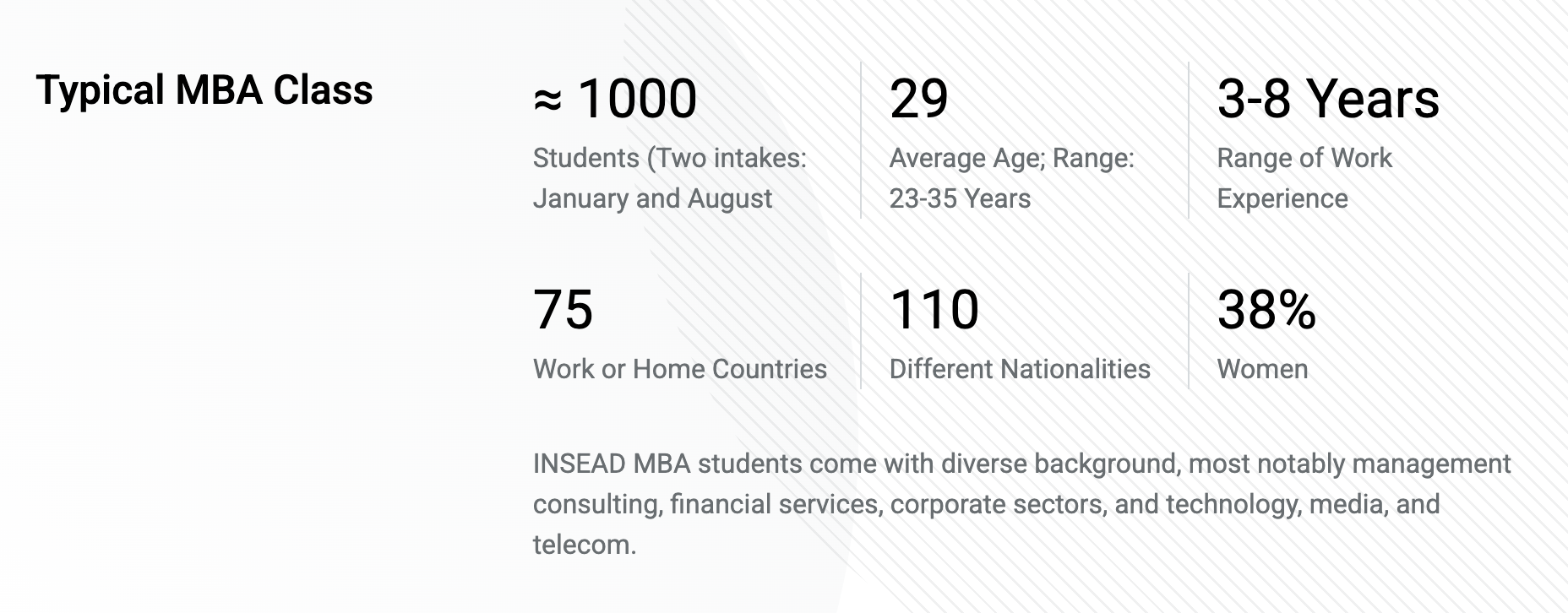
Beyond the impressive statistics, though, INSEAD is a highly values-driven community that values diversity, adaptability and teamwork — and professionals who are adept at putting these values into practice in their daily lives.
According to INSEAD’s admissions committee:
“The MBA Admissions team are looking for people with intellectual curiosity, personal qualities to contribute to the many INSEAD activities and a desire to stretch themselves in a rigorous academic programme. We welcome applications from around the world regardless of race, religion, gender, colour or financial status. Our aim is to build an exciting, dynamic and diverse student body.”
If this sounds like a community in which you’d be right at home, you’ll first have to prove you’ve got what it takes by successfully answering INSEAD’s highly varied, challenging admissions essay questions.
2. How should I answer INSEAD essay questions?
Writing any admission essay is a tough task, however, INSEAD requires applicants to submit a highly-challenging set of several essays that discuss everything from personal characteristics, to difficult situations, to future plans, to extracurricular activities.
Keep reading for a more in-depth look at how to turn this advice into outstanding essays!
2.1. Motivational Essay 1
Give a candid description of yourself as a person and a leader, emphasizing the strengths and weaknesses you recognize in yourself. Explain how you are actively working on your development, sharing key experiences that have shaped you, providing specific examples where relevant. (500 words)
Considering the fact that you only have 500 words to present yourself, this essay can seem like a daunting task. However, we have found that the following structure helps this essay flow nicely and perfectly nail the brief.
We suggest including two strengths and one weakness (in any order you prefer), and a theme to connect them all.
As you can see in Motivational Essay Sample Set 1 (available for download below), the author uses his passion for digital as the theme for his essay, comparing various technical processes to strengths and weaknesses in his personality before ending by stating his working to become version 2.0 of himself.
Many people argue initially that their personality should be enough of a theme. This can definitely work, however, we have found that a more robust theme that integrates with and connects to your characteristics makes for a more interesting, cohesive essay. It will also help you discuss what led you to develop the unique characteristics that make you you!
Finally, please (please!) do not use a fake or made up weakness. Your weakness should be thoughtful, yet appropriate for business school.
Talking about how you often fight with superiors, for example, is not appropriate for business school, since the experience is inherently collaborative and teamwork driven, so make sure you don’t build an argument that you have a hard time relating to others. Furthermore, answers like losing your temper easily or being lazy are not good choices.
You also don’t want to stray too far to the other side, choosing answers like “I work too hard.” Instead, choose real, well-considered weaknesses and include information about why this personal trait is a weakness.
REMEMBER: your weaknesses should be an obstacle to other strengths and NOT one of your inherent flaws.
For example, if you tend to get lost in the details, show the adcom that this has led to negative feedback at work, where you’re increasingly asked to take care of your team’s big picture responsibilities.
Finally, end by showing how you are working on this weakness. The important thing here is not to show you are a “perfect” person, but to show them that you are mature, self-aware, and focused on self-improvement.
TOP TIP: There is a lot of space for repetition with Essay 2, so we suggest planning out all your examples for all essays and double-checking for any conflicts before you start writing.
2.2. Motivational Essay 2
Describe a highly stressful situation you faced and how you managed it. What did this experience teach you about yourself and your interactions with others? (400 words maximum)
New for the January 2026 application, this essay is your opportunity to highlight how you navigate high-pressure situations while working with others, a critical aspect of leadership that INSEAD values. To craft a strong response, start by selecting a specific stressful situation where the stakes were high, and your ability to manage both the challenge and your interactions with others was tested. Ideally, choose an example that highlights your role in leading, influencing, or collaborating with others to achieve a positive outcome.
Set the scene by briefly describing the context of the situation. Focus on the complexity of the challenge, the roles of the people involved, and what was at stake. For instance, was this a crisis at work that required you to coordinate with multiple teams under tight deadlines? Or was it a personal challenge where you had to rely on emotional intelligence to mediate conflicts or rally support?
As you describe your actions, emphasize how you engaged with others to navigate the stress. Did you delegate effectively, inspire confidence, or mediate conflicting perspectives? Highlight the specific strategies you used to ensure that everyone remained focused and productive despite the pressure.
Make sure you use the STAR framework (Situation, Task, Action, Result) to structure your narrative. Keep the description of the situation concise and focus more on your actions and reflections.
The most critical part of the essay is your reflection on what you learned about yourself and your interactions with others. Consider how this experience shaped your understanding of communication, teamwork, or leadership. For example, did you discover the importance of listening more actively, motivating others through empathy, or fostering trust in challenging circumstances? Share insights into how this experience influenced your leadership style and how you approach working with others in high-stakes situations today.
INSEAD values leaders who are not only resilient but also collaborative and self-aware. Use this essay to show that you don’t just manage stress—you thrive in it by working effectively with others, understanding their needs, and guiding them toward solutions. By framing the situation as a learning moment that deepened your understanding of leadership and interpersonal dynamics, you can demonstrate that you are well-equipped to contribute to INSEAD’s diverse and collaborative environment.
2.3. Optional Motivational Essay
Is there anything else that was not covered in your application that you would like to share with the admissions committee? (300 words)
As with nearly all elite business schools, INSEAD does not want to see a summary of your profile or a restatement of why you want to attend INSEAD. Considering they give you 8 other essay questions and a video essay, you have plenty of space to make your most important arguments within the confines of the application.
However, if you have extenuating circumstances that merit additional explanation (a good overview of what kind of circumstances qualify can be found here), make sure to explain them clearly and directly.
2.4. Activities Essay
Describe the activities you listed above and explain how they have enriched your life (e.g., skills developed, personal growth, community impact). (300 words maximum)
Before answering this question, you’ll be required to fill out a short form where you’ll detail the activities you’re involved in.
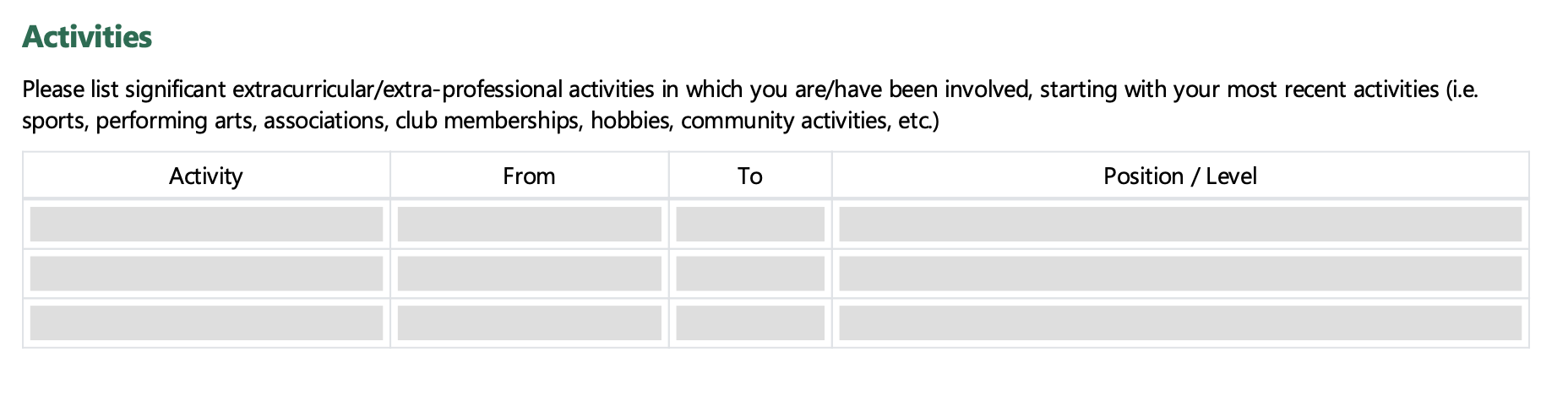 Source: The INSEAD application
Here, we suggest choosing a few different activities you currently participate in (or have meaningfully participated in previously).
These can be a range of activities, from hobbies to community service to sports, etc. If you can, try to choose activities that reinforce you’re a globally-minded, team-oriented person and use this space to highlight new elements of your profile that you did not discuss elsewhere.
No matter what you choose, you must justify how each activity has enriched you.
You don’t have to get overly dramatic here and state that soccer saved your life (if it did, though, write about that!), but make sure to show a mature, thoughtful analysis of how this activity has led you to grow as a person.
2.5. Job Essay 1
Provide a summary of your career since graduating from university, explaining the rationale behind your key decisions and career progression. Include a description of your current (or most recent) role, covering the scope of your work, major responsibilities, employees under your supervision, budget size, clients/products, and any notable results achieved. (500 words maximum)
Here, INSEAD does not want a 2-page dramatic retelling of your CV, so make sure you start writing this essay with your ultimate goal in mind.
We suggest applicants take this opportunity to show the “whys and hows” of their career choices thus far, specifically focusing on what led you to move from one company or role to another and what you learned. It’s also a good practice to highlight any of your “blockbuster” moments to establish a track record of excellence in your career.
Furthermore, show the adcom your career is on an upward trajectory by including information about increased responsibilities with each new role.
As for size, try to keep it short, but use your best judgment. If you’ve had 10 positions since graduating from university, this part of the essay will likely be longer than someone who has had 2-3 positions at one company in the same amount of time.
Once you get to the part of the question about your current role, the most important thing is to answer all elements of the question and maintain focus on your current role.
If you’re currently working on a particularly interesting project, you can include information about the project and your related responsibilities, but don’t bog your reader down with an exhaustive list of every project and result you’ve ever obtained in your current role.

Finally, make sure to include the data they ask for, specifically related to budget and number of people you manage.
2.6. Job Essay 2
Describe your short and long-term career aspirations, including your target geography, industry, and function. How do you plan to bridge the gap
between your current position and these goals, and how will INSEAD help you achieve them? (300 words maximum)
Unlike many other schools, INSEAD poses a very straightforward goals question that asks you to discuss your short-term and long-term goals, as well as your need for an INSEAD MBA.
Considering the fact that you’ve just told the admissions committee about your past experiences, we recommend jumping right in and starting to discuss your short-term goal, namely, the job you hope to have right after graduation.
Then, continue by discussing why you want to pursue this goal, before moving on to stating your long-term goal (this varies, but somewhere in the 5-10 year range is a good target) and the reason for wanting to pursue this goal as well.
Though it can be tempting to be vague or generic here, that’s not going to help your application.
INSEAD, like all elite business schools, will use this essay to determine your career risk (i.e. the likelihood of you getting the job you’ve said you want after graduation). As such, specificity is an absolute necessity (include both title and industry).
Finally, if you’re pursuing goals that are very loosely related to what you’ve done thus far, make sure you fully explore why you’re making such a drastic change and give any evidence you can that you’ll be successful in making this big shift.
Show the admissions committee you recognize that you still need to grow as a person and as a professional in order to successfully reach the goals you’ve laid out. To do this, consider key skills that you need to build or develop that are specifically related to your plans.
For example, if you’re planning to pursue partnership at a major consulting firm, pitching clients will become a huge part of your job description, so improving your abilities to do so is important.
On the other hand, if your post-MBA goal requires managing a huge team, you may want to think about how you need to grow as a leader and manager to successfully rise to the occasion.
Second, you should clearly demonstrate why you need an MBA.
 Source: @insead on Instagram
An MBA is not a catch-all degree that serves a purpose for all career paths. As such, you need to demonstrate that the goals you have set for yourself require the additional training an MBA can provide.
Be thoughtful about this particular section. If you don’t need to improve in any meaningful way, you might be presenting the argument the admissions committee needs for why you can’t actually benefit from an MBA.
Furthermore, if you show fluffy or unsupported reasons you need to hone your skills, you’ll also likely see your application tossed aside in favor of an applicant who was able to clearly demonstrate how they plan to leverage their time at business school.
Third, add how INSEAD can specifically help you grow in the areas you’ve identified. Mentioning that you want to go to INSEAD because of its ranking will not cut it here.
Instead, show that you understand the unique offerings INSEAD’s curriculum provides and have done significant, thoughtful research into how the opportunities both inside and outside of the classroom can help you grow.
Finally, it’s worth mentioning how and why you might benefit from being part of INSEAD’s highly global MBA. Regardless of what you choose to write about, make sure you do extensive research into the INSEAD program and deeply reflect on your future goals before you start writing.
TOP TIP: Not sure how to define your goals for your MBA application? Check out our guide on the topic here!

3. Feeling Overwhelmed with the MBA Application Process?
The hardest part of MBA essays isn’t finding stories to tell. Instead, it’s finding the right stories and shaping them into something that matters. It’s the gap between the messy, complicated truth of your experience and the clear, compelling narrative that admissions committees need to understand who you are. That’s where most applicants get stuck because they’re too close to their own story to see what’s working and what’s noise.
The right essay support doesn’t just polish your grammar. It helps you find the beating heart of your narrative and bring it to the surface. Leland connects you with vetted essay coaches who do exactly that, from former admissions officers who’ve read thousands of applications and know what creates impact, to experienced consultants who specialize in turning raw ideas into compelling stories, to current students who just went through this and can help you see what your schools are actually looking for. You can work with them however you need: one session to brainstorm your approach, multiple rounds of editing and refinement, or just a sanity check before you hit submit.
Getting feedback from someone who understands your goals, your schools, and how to make every word count makes all the difference in standing out at top MBA programs and landing a spot at your dream school.

We earn a small commission when you book coaching through our link, which helps support the free resources we create.