UPDATE: This article was originally posted on July 23, 2018. It has been updated with new information and tips below.
When many people think of “business school,” the first MBA that pops into their mind is Harvard Business School. Established in 1908, HBS has been at the forefront of business education for more than a century.
However, receiving nearly 10,000 applications per year, Harvard Business School is one of the most difficult MBA programs to enter.
That’s why we’ve prepared this guide to help you use your Harvard admissions essays to stand out. We’ve rounded up our best tips and links to Harvard Business School MBA sample essays to ensure you give your HBS application your best shot.
1. Who is Harvard looking for?
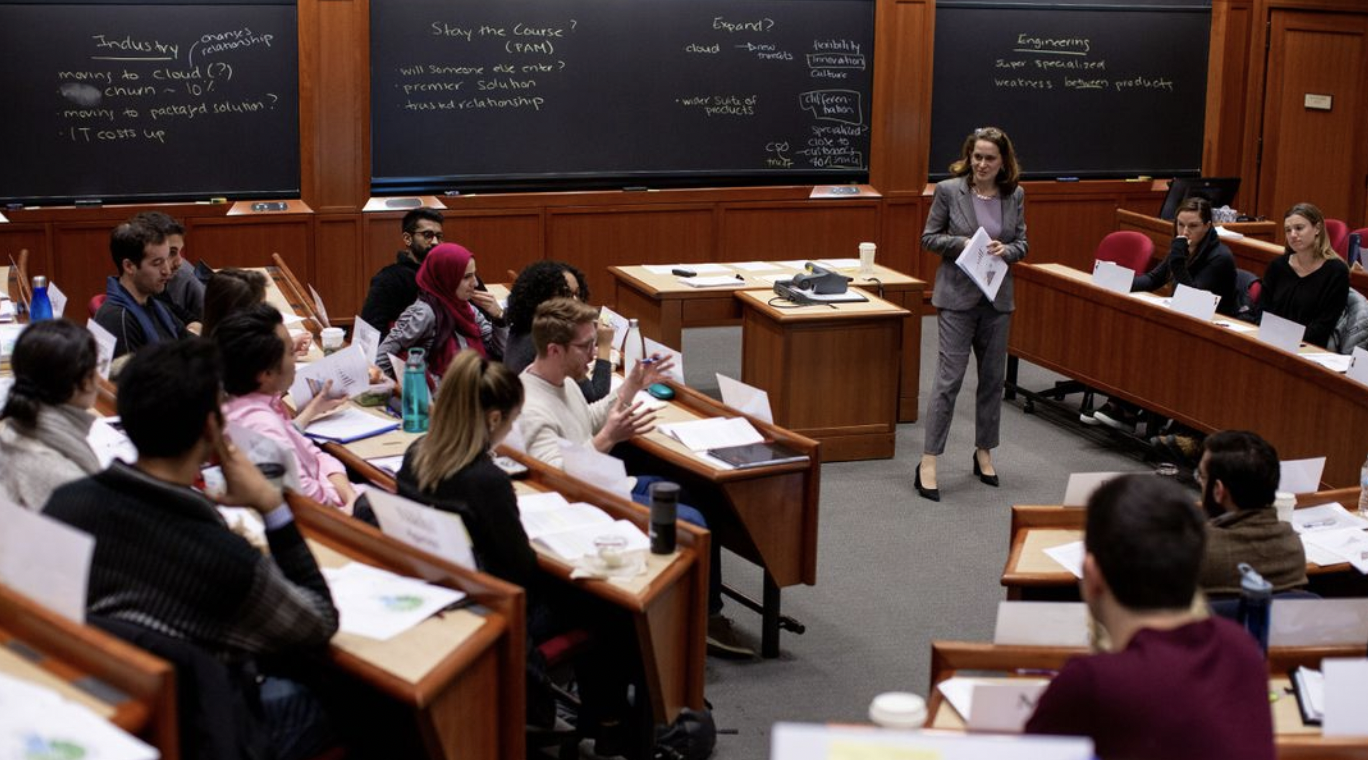 (Photo courtesy of @harvardhbs in Instagram)
Every year, Harvard Business School admits the largest single MBA class in the world, with around 1000 students starting each year. The class is highly competitive. Find full class profile stats here.
In addition, some of the key characteristics HBS looks for in applicants are:

If this sounds like a community in which you’d be right at home, you’ll first have to prove you’ve got what it takes by successfully answering Harvard’s essay questions.
2. How should I answer Harvard essay questions?
2.1 Goals short answer tips
Briefly, tell us more about your career aspirations (500 characters, including spaces).
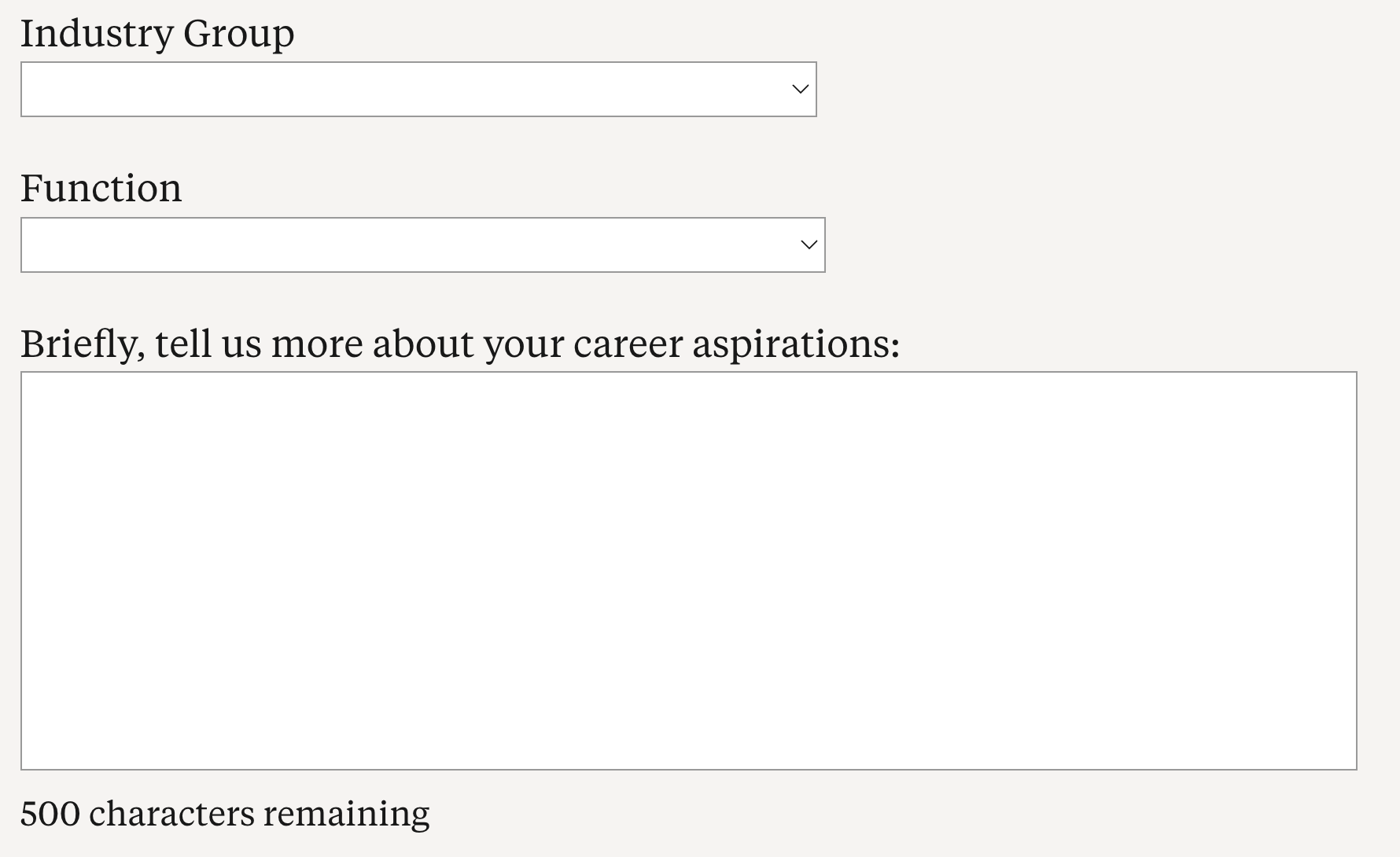 Source: HBS’ website
First, you’ll need to choose an industry group and function from the drop-down menu below. This should be directly related to your short-term goals. Try to match your goals as closely as possible, as not all goals will have exact matches on the list.
Then, you’ll see a box where you have 500 characters to share your goals. In the box, directly state your short-term and long-term goals in simple, clear terms. You have a whole essay to talk about the impact and motivation behind your goals, so you don’t need to focus on that here.
If you’re struggling to define your goals for the MBA, check out this post!
2.2 Essay 1 tips
Business-Minded: Please reflect on how your choices have influenced your career path and aspirations. (up to 300 words)
To start things off, HBS asks this goals-type essay after requiring that you specifically outline your goals in the employment section of the application. However, with only 300 words, HBS forces you to clearly state some of the most fundamental — and important! — information in your MBA application.
First, we suggest that you review how HBS defines “business-minded” and how they expect to see this in your application.
 Source: HBS’ website
You have a 500-character short answer in the application form itself where you need to state your short and long-term goals, so there is no need to restate them here. You can just jump right into the experiences that have influenced your career choices.
We do suggest that you start off the essay with context into why the goals you’re pursuing are right for you. This might be a STAR-format story (or 2 mini STAR stories) that is related to your goals or part of your personal track record that motivated you to pursue the goals you stated. Make sure that the story or stories that you choose are all directly related to your career goals and that you can make a clear link between them and your career path both now and in the future.
If it helps you to briefly mention your goals (think a few words here) to help transition your essay from past to future, you can briefly mention your career aspirations on a high level. For example, you might use something like, “Looking ahead, as a leader in the healthcare space…” and then continue on with the second part of the essay.
In the second part of the essay, the focus is all on impact. Here, you want to be crystal clear about the legacy you hope to leave behind with your goals.
The question asks you to think about impact beyond just your own career and prompts you to consider the impact your goals will have on businesses, organizations, and communities. We always encourage our clients not just to think about the direct impact their goals will have but also how their goals will make the world a better place.
For example, if you want to launch a startup that offers services to SMBs, which are currently underserved in your country, make sure to show how this will impact the business landscape, as well as how it will make the lives of those your company will improve as a result of using your service.
Additionally, we often encourage clients to think about the concept of a “parallel goal.” For example, if your main goal is to move up the ranks in the private equity industry, perhaps your parallel goal is to continue the work you’ve done to break down gender barriers in the male-dominated finance industry. Or, if you’re planning to become an operations-focused consulting partner, perhaps your parallel goal is to serve as an example for other LGBTQ+ leaders in your firm and continue mentoring younger professionals in your industry.
If you do have a parallel goal, make sure that it connects with your previous track record. You don’t want to mention how you’re dedicated to mentoring others in your future career if you’ve never mentored anyone before, as this will come across as inauthentic. If you do mention this type of goal in addition to your “main” goal, make sure you also show the impact you hope it has.
In short, make sure you consider the wide-reaching impact of your goals and clearly state it. It’s also a great idea to back this impact up with why you’re passionate about pursuing these goals at some point in this section since your passion for your future is what makes your career plans come alive!
2.3 Essay 2 tips
Leadership-Focused: What experiences have shaped how you invest in others and how you lead? (up to 250 words)
This question is challenging because it asks you to cover so much ground in just 250 words.
First, we suggest that you review how HBS defines “leadership-focused” and how they expect to see this in your application.
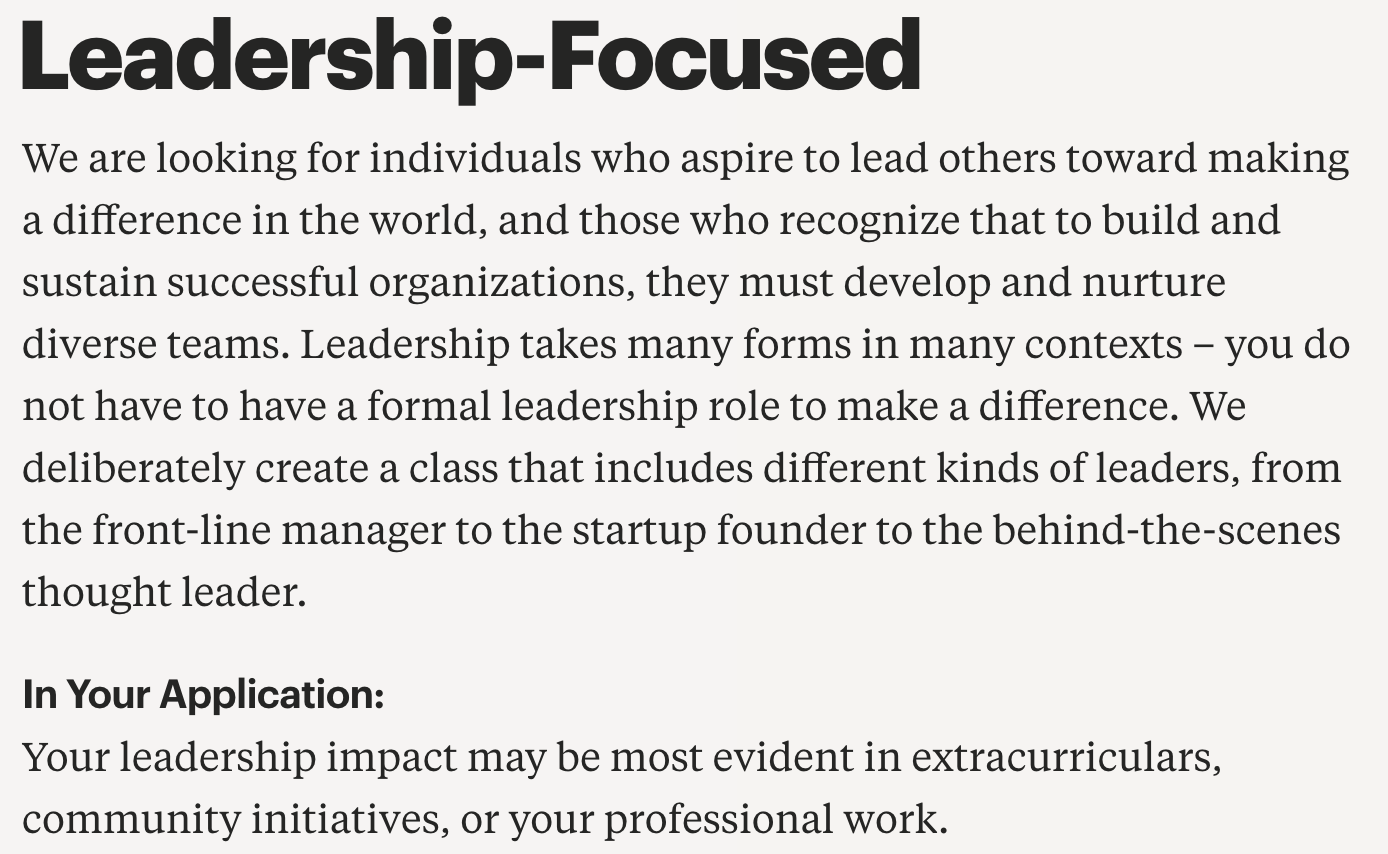 Source: HBS’ website
Then, start with a reflection on your leadership style. You need a clear definition of your leadership approach here for this essay to work effectively. It’s short, so bringing in stream-of-consciousness explorations of leadership or examples that are all over the place will demonstrate a lack of coherence and focus that won’t impress the adcom.
Once you’ve thought about this, work on developing a list of your best leadership examples. We suggest one personal/extracurricular and one professional story, if you can and if it’s aligned with your leadership theme. This shows a great range of leadership and demonstrates that you’re a leader not just because it’s required of you at work but also because you seek to lead and make an impact wherever you find yourself.
After choosing your examples, it’s time to start writing. We suggest you start with a hook intro that brings in some type of wording that directly states your overall leadership style or focus. This will give the essay the organization and coherence we’re looking for while also grabbing the adcom’s attention.
Then, bring in your two leadership examples. You won’t have space for long STAR-format stories here, so you want to summarize them in a few sentences. Make sure you still cover what happened, how you demonstrated leadership, and the results/what you learned in the end. Considering the word count of the essay, we suggest you spend ~120 words for each example.
Then end with a killer conclusion that ties it all together. You may wish to dedicate a few words to how you see yourself continuing to grow in your leadership style, though this is no longer required in this question.
2.4 Essay 3 tips
Growth-Oriented: Curiosity can be seen in many ways. Please share an example of how you have demonstrated curiosity and how that has influenced your growth. (up to 250 words)
First, we suggest that you review how HBS defines “growth-oriented” and how they expect to see this in your application.
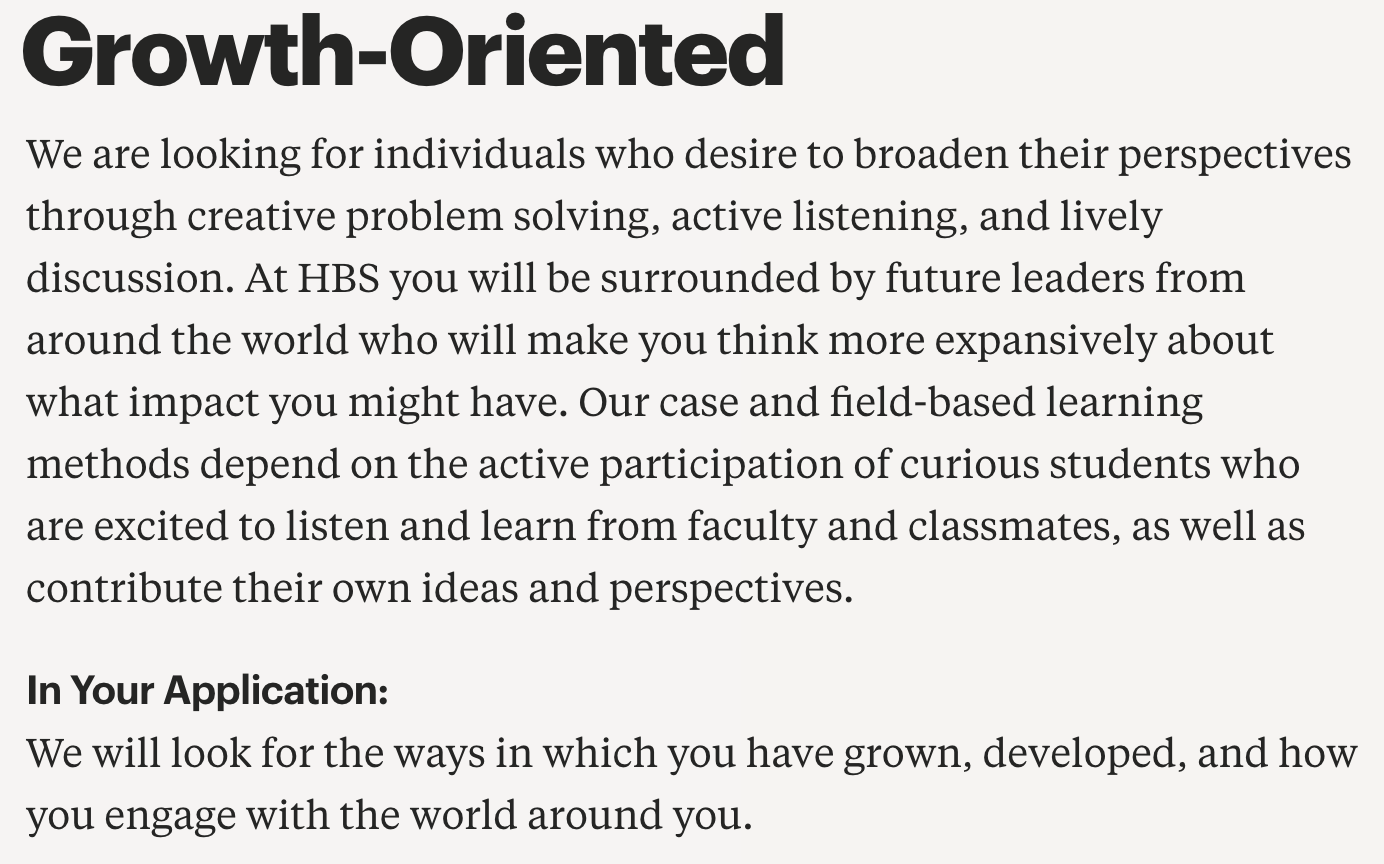 Source: HBS’ website
Though you may be tempted to cram in as many examples of curiosity as you can in this question, HBS clearly asks you for a single experience, though they do not dictate that you must draw this example from your professional experience.
As such, considering the fact that you want to show growth in this example, brainstorm a list of examples in which you faced a clear challenge and were able to overcome it using curiosity.
Does the question say there has to be a challenge? No.
Do essays where applicants use overcoming challenges as a platform for demonstrating skills tend to work better than others? Yep!
So, we suggest focusing on examples where your curiosity was key in solving the problem you faced. As such, an example where applying your already expert programming skills was what helped you face down the challenge won’t work well here.
Instead, think of examples rich in creative problem solving, like learning a new skill to ensure a solution was reached or even demonstrating active listening and understanding both sides of an argument to resolve conflict.
Finally, make sure your story has a clear outcome or resolution and that it impacted your growth as a leader or person in some way.
When you start writing your essay, begin with a hook introduction that sets the stage and makes your reader want to keep reading to find out what happens.
Then, show the challenge you were facing. When writing this essay, do not skim over the conflict part of your story. Though we work hard to avoid conflict in real life, a bit of conflict in your story here demonstrates your curiosity applied to real life. Finally, we truly feel you should stick to the STAR framework to ensure you deliver a winning answer.
Continue by showing what you did (this is the part in which you’re actively demonstrating your capacity to lead). During this section, focus on showing how you accomplished what you did and why you felt the actions you took were appropriate for the challenge.
End your essay by showing the result you were able to achieve (we suggest you focus on examples with positive outcomes), what you learned, and specifically how you grew in some concrete way as a result of the experience.
Top Tip: It’s important to specifically call out “curiosity” in this essay. This will ensure that you fully and clearly answer all aspects of the prompt. Make sure, however, that you are specific about your curiosity – how you applied it, what you learned, etc. Don’t just name-drop curiosity and keep going. Make sure it’s an integral part of the story.
2.5 Optional Essay tips
Please share additional information here if you need to clarify any information provided in the other sections of your application. This is not meant to be used as an additional essay. Please limit your additional information to the space in this section.
We know you’ll be tempted, but please don’t send us any additional materials (e.g., additional recommendations, work portfolios). To be fair to all applicants, extra materials won’t be considered. (75 words)
This section should only be used to convey information not addressed elsewhere in your application, for example, completion of supplemental coursework, employment gaps, academic issues, etc. Feel free to use bullet points where appropriate.
Though with such a short application you may be tempted to use this response to add additional stories and information you couldn’t quite squeeze in elsewhere, restraint is necessary here. Make sure you focus on explaining gaps in your application only, though you can use these explanations to highlight related achievements.
You only have 75 words, so you’re only going to be able to state the facts!
We have written extensively on the issue of optional essays, giving tips and tricks for how to address issues like low GMAT scores or poor academic performance here.
2.6 Reapplicant Essay tips
Please use this space to share with the Admissions Committee how you have reflected and grown since your previous application and discuss any relevant updates to your candidacy (e.g., changes in your professional life, additional coursework, and extracurricular/volunteer engagements). (250 word limit)
We have written a separate post on the topic of reapplying to business school, including insider tips and tricks to help make sure your second shot at your dream school is successful.
3. This Isn’t Just Coaching. This is Elite-Level Strategy that Gets You Results.
Whether you need a single hour of interview coaching or a comprehensive application strategy, Leland makes it easy to find the right consultant for your situation. Their platform has vetted experts across the full spectrum, from former admissions officers from top programs to professionals working in your target industry to industry-leading experienced MBA consultants. You can filter by expertise, read verified reviews, and book exactly the scope of help you need at a price point that works for you.
Not sure where to start? Leland’s team helps match you with consultants based on your profile and goals, whether that’s essay strategy, interview prep, school selection, or full application support. Leland has made it genuinely easier to connect with quality coaches without the guesswork.
Check out Leland and find the support you need to get into your top-choice MBA.

We earn a small commission when you book coaching through our link, which helps support the free resources we create.
4. Deadlines
The HBS MBA deadlines for the 2026-2027 season are below. You can access the HBS application here.
HBS MBA Round 1 Deadlines
Application Deadline: September 9, 2026
Interview Notification: TBD
Decisions Released: December 10, 2026
HBS MBA Round 2 Deadlines
Application Deadline: January 5, 2027
Interview Notification: TBD
Decisions Released: March 25, 2027
HBS MBA 2+2 Deadlines
Application Deadline: April 22, 2027
Interview Notification: TBD
Decisions Released: June 25, 2027