
With its focus on ethical leadership and social impact, Oxford is at the top of the list for an increasing number of applicants who seek to pursue (or continue pursuing) a high-impact, global career.
However, with impressive recruiting statistics and its unique 1+1 MBA + Master’s program, the competition to join Oxford’s elite MBA is more difficult than ever.
That’s why it’s so important to nail every aspect of your application – including the video interview.
In addition to giving the admissions committee the chance to “put a face with a name,” the video essay is an essential part of the Oxford Saïd application, as it allows committee members to determine if your communication style and values are a good fit with the Oxford community.
In fact, in our experience helping our Oxford applications secure a place at the school, we have noticed that the video essay is just as influential in an applicant’s admissions decision as the admissions interview.
That’s why we’ve prepared this guide to help you understand how the Oxford video interview works and have shared our best tips to ensure you record an outstanding video essay that ensures you pass through to the interview round.
Why does Oxford require a video essay?
The video interview gives the Oxford admissions committee the chance to truly “meet” candidates — as well as identify red flags in potential members of the school’s community.
According to Oxford’s admissions committee, here is what they expect:
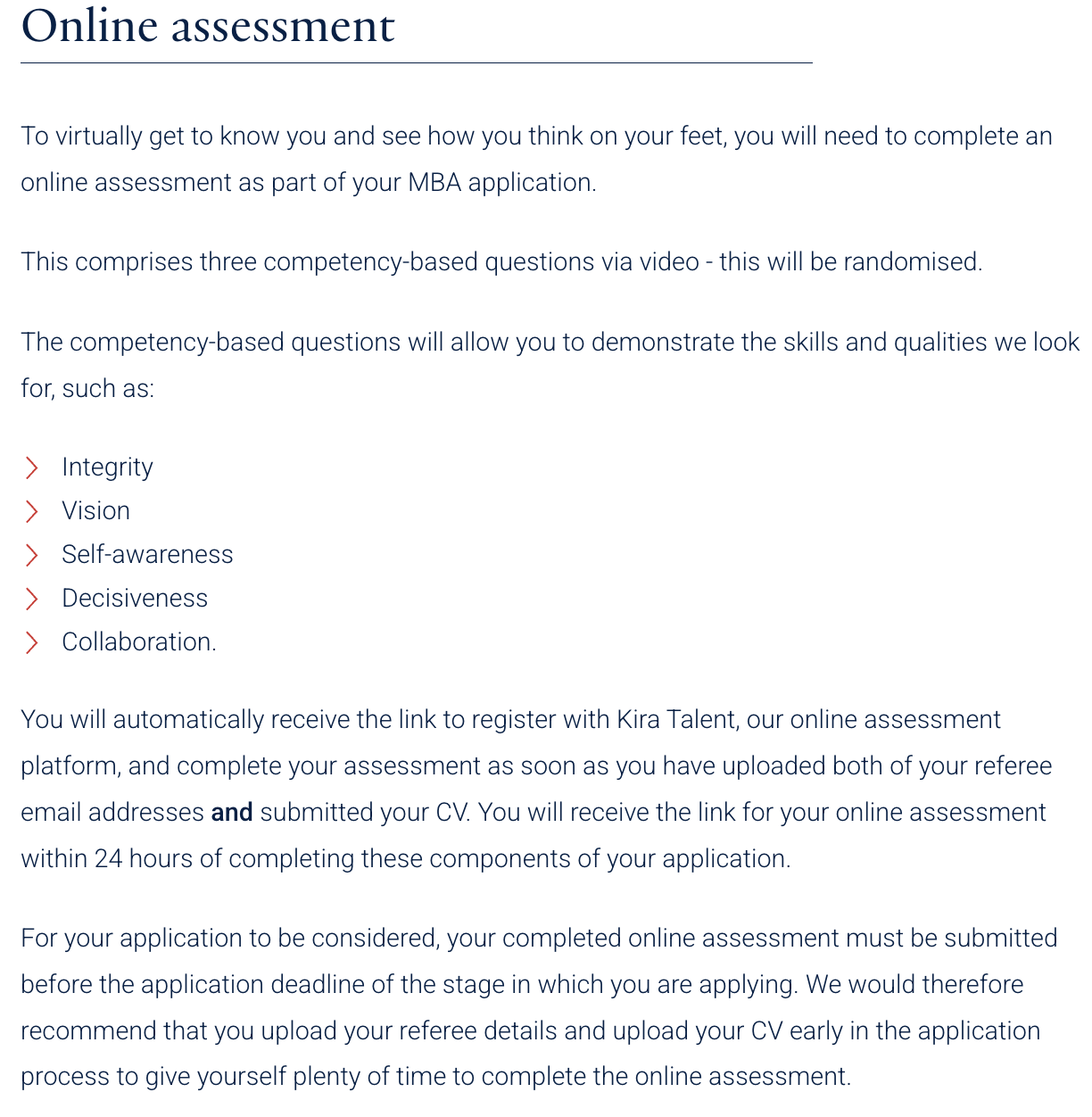 With that in mind, it’s extremely important to make sure you fully understand this component of the application.
How does the Oxford video essay work?
The way the video essay works is very simple.
After submitting your application, you will receive an email from a company called Kira Talent. This email will contain a link that allows you to access the video essay platform.
After receiving each question, you will have 20 seconds to think and then 90 seconds to answer. There are no opportunities to redo the question, and you only get one chance to speak and provide your answer.
Technical requirements
To complete the video interview, you need a microphone, camera, and strong internet connection. Though the platform states you can complete the video essay on your mobile device, we have found that this does not consistently work.
Furthermore, given past applicants’ issues with the iPad version of the application, we strongly suggest you record your answer on a computer.
If you do end up experiencing technical issues, access the support page here.
Deadlines
Regardless of when you submit your application, you need to submit your video essay response by your chosen round’s deadline. Once you submit the application, you will gain access to the Kira link to record your video interview within 24 hours of submitting. Don’t wait to submit your application last minute, however, since you will not receive extra time for your video interview! Find Oxford’s most current application deadlines here.
If you submit your application early, you can submit the video essays at any time, as long as you make the final deadline.
Answer Time Limits
After receiving each question, you will have 20 seconds to think and then 90 seconds to answer. There are no opportunities to redo the question, and you only get one chance to speak and provide your answer.
Which types of questions are asked?
Oxford asks 3 questions. This year, all of our clients have reported being asked only competency-based questions.
Oxford is a community that values purpose-driven, adaptable people who work well in teams and are strong problem-solvers.
For that reason, Oxford often asks questions aimed at determining if you have the skills and qualities the school looks for and will be a positive addition to the Saïd community.
These questions won’t specifically ask, “Do you like working in a team,” but if you can keep in mind that this is a chance to show how you interact with others, you’ll have a good starting point for this question.
Sample Competency-based questions
- Tell us about a time you overcame a challenging situation, either personally or professionally. What was your approach to resolving the situation?
- What would you do if you and your teammates were unable to come to an agreement about how to approach a project?
- Share a time when you and your team were under a lot of pressure to meet a short deadline. What did you to do ensure the deadlines were met?
- Tell us about a time you took a risk. What did you learn?
- Tell us about a time you experienced a professional failure. What did you learn from it?
- Tell us about a conflict you have had with your boss/with a team at work. How did you manage to resolve it?
- Tell us about an organization or activity to which you have devoted a significant amount of time. Why was it meaningful to you?
- Tell us about a relationship you leveraged to reach your goals and how you did it.
- Tell us about a time when you had to deliver a tough task at the last minute.
- Tell us about a time when you solved a problem in a creative way.
- What is the most significant personal weakness that you have identified, what did you do about it, and what was the result?
- Imagine you are proposing a business innovation idea for a class project and the audience is not interested. What would you do?
- Tell us about a time you had to ask for help. How did it go and what did you learn from it?
- Tell us about a time you asked for help and how did it go?
- Tell us about a time you were overloaded with work, how did you handle it?
- What is the most significant personal weakness that you have identified, what did you do about it, and what was the result?
- Discuss what you would do if you and your teammates cannot come to an agreement on a project decision.
- Tell us a time when you had an idea and had to convince your project team.
- Tell us about a time you were overloaded with work, how did you handle it?
- Tell us about a time you led a diverse team, what specific skills did you use to ensure success and why?
To do well in this question, it’s great to draw on examples, and to be clear and to the point.

Furthermore, make sure to show your human side and demonstrate that you genuinely care for others and want the teams you join to succeed. It can be easy to answer in a very conversational way, but doing so can often lead to an answer without a point, so make sure to structure the key elements of your answer.
For this question, you want to make sure you’re showing what you do and use active language.
Your answer will want to show that you’re mature, that you’re emotionally intelligent, that you can see the bigger picture, that you’re empathetic, and that you make a positive contribution to those around you.
If the question is about helping someone with a problem, tell us what you do. Perhaps you first like to listen, then help them get clear on what they really want, and then decide together on some next steps.
If the question is about your management style, be precise. Tell them how you manage people and why. Maybe you’re very hands-off, and like to give everyone the opportunity to take responsibility within their role, as you think this empowers them the most to learn and develop. Maybe you’re more hands-on and like to make sure your team knows they can come to you with problems, as giving people too much freedom too soon can actually be overwhelming to them.
Regardless, make sure to show your reasons for your actions and demonstrate that you’re a person who embraces collaboration and who sees setbacks as opportunities for learning.
The difference between a good and great video essay
Given the importance of the video essay in your Oxford Saïd application, it’s crucial to make sure you don’t just have a good video essay, but that you have a great video essay.
Now that you’ve learned how the video essay will work, we’ve gathered our top 5 tips here to ensure your video essay performance brings you one step closer to reaching your goal of attending Oxford.
Make sure you get into Oxford Saïd
No two schools define the “ideal profile” the same way, and My Admit Coach is the only platform designed to help you tailor your story with precision.
Built on thousands of real admissions outcomes and over a decade of consulting frameworks from the world’s #1 rated MBA consultant, it reveals what each school truly values, and helps you align your essays, goals, and interview answers to match.
With school-specific simulations that replicate admissions committee discussions, you’ll get clear, actionable feedback on how your materials are likely to land, before you ever hit submit.
Every insight, prompt, and suggestion is backed by data from successful applicants and powered by our proprietary AI developed with Silicon Valley AI experts.
It’s insider-level, $10K guidance, made accessible to every applicant for less than $300.
With My Admit Coach, you’ll build an application that feels personal, precise, and perfectly aligned with Oxford Saïd.